Searching...
 Carl Rogers
 Marshall Rosenberg
 Richard Schwartz
Do Red Heads have a right to practice NVC ?
Step 1
Red Hair Nations
Step 2
Flying Monkeys
Executive Summary
Trauma Bonding 101
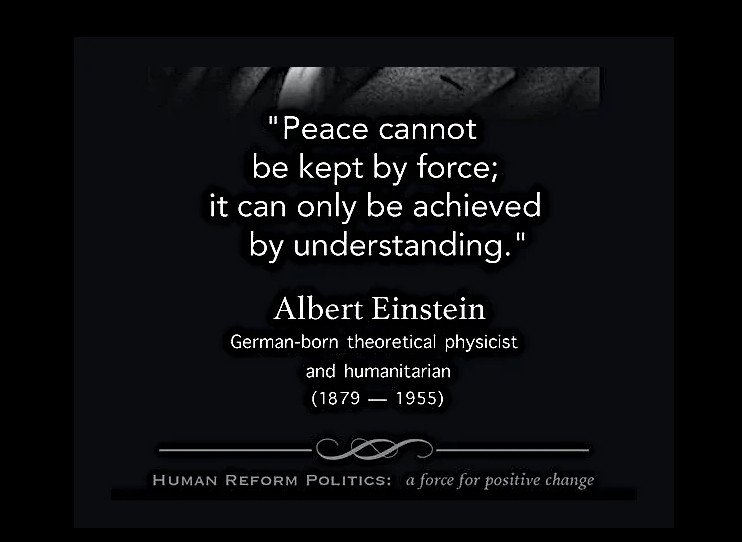
“All war is a symptom
of man’s failure
as a thinking animal.”
War is not an inevitable outcome, but a result of man’s proud refusal to use reason, dialogue, and empathy to explore strategies that meet everyone’s needs.
It implies that resorting to fear and violence is a regression from our natural potential for peaceful thought, and that peaceful solutions are the hallmark of a truly evolved, intelligent species.
A failure of reason: The quote proposes that war is a failure of human intellect because it replaces rational problem-solving with physical aggression rooted in a mentality of domination.
A symptom, not a cause: Steinbeck frames war as a symptom of a deeper human failing—the refusal to resolve disputes through more thoughtful means like diplomacy and understanding.
An appeal to higher potential: The quote serves as a challenge to humanity, encouraging the elevation of our thinking beyond fear and conflict toward a more peaceful life on Earth.
War is not a sign of strength: In this view, war is a sign of weakness in the ability to manage fear, resulting in destructive reactions over a selfish, feverish. squeamish, fear of sharing.
From the Perspective of Historical Sociology
(The Mechanics of Domination)
- Consolidation of Power: Early states and empires (such as the Aztecs, Shang Dynasty China, or the Mississippian cultures) used the ultimate power—the right to take human life publicly—to signal absolute authority.
- The “Social Stratification” Hypothesis: Sociological research suggests that human sacrifice was heavily utilized to sustain and legitimize strict class systems.
It sent a terrifyingly clear message: the elites control the cosmic order and the physical survival of their subjects.
- Foreign Policy and Warfare: Sacrificing captured enemies transformed military domination into a grand, state-sanctioned theater, reinforcing the subjugation of conquered territories.
(The Sacred and the Symbolic)
- The Economy of the Sacred: In ancient worldviews, life was a gift from the gods, and debt could only be repaid with the ultimate currency: life itself. Domination over a victim allowed the group to broker a transaction with the divine.
- Scapegoating and Social Cohesion: Drawing from theories like René Girard’s “mimesis and the scapegoat,” anthropology posits that internal community tension and violence are redirected onto a single sacrificial victim. Surviving this shared violent act creates a powerful bond of solidarity among the remaining group.
- Cosmic Maintenance: Anthropologists highlight that for many ancient cultures, sacrifice was viewed as a necessary mechanism to prevent cosmic collapse, ensure agricultural fertility, or keep the sun rising. Domination over the victim was framed as an act of cosmic duty.
Historical sociology provides the who and the how (the rulers using force to dominate the ruled), while ancient anthropology provides the why (the sacred framework that made the populace accept, fear, or even revere that violence).
While the ultimate horrors of the Holocaust and the mass extermination camps were independently engineered by the Nazi regime, the legal frameworks they used to isolate, dehumanize, and legally strip Jews of their rights were heavily modeled after American precedents. [1, 2]
The landmark research on this subject is found in the book Hitler’s American Model: The United States and the Making of Nazi Race Law by Yale Law School professor James Q. Whitman. Whitman’s research outlines how Nazi jurists explicitly used American law to draft the 1935 Nuremberg Laws: [1, 2, 3]
- Anti-Miscegenation Laws: In 1930s Europe, criminalizing interracial marriage was virtually unheard of—except in the United States. Nazi lawyers meticulously studied transcripts from about 30 U.S. states that banned and criminalized marriages between white people and Black, Asian, or Native American individuals. This served as the blueprint for the Nazi Blood Law, which banned marriage and sex between Jews and non-Jewish Germans. [1, 2, 3, 4, 5]
- Second-Class Citizenship: Nazi lawyers looked at how the U.S. successfully maintained a multi-tiered citizenship system. They noted that through Jim Crow laws, as well as federal laws governing Native Americans, Filipinos, and Puerto Ricans, the U.S. was able to deny full civil rights to millions of people born on its soil. The Nazis used this structure to craft their Citizenship Law, reducing German Jews to non-citizen “nationals.” [1, 2, 3, 4, 5]
- Where the U.S. was “Too Harsh”: Strikingly, Whitman notes instances where Nazi legal scholars found American law to be too radical. For example, the American “one-drop rule” (classifying anyone with any Black ancestry as Black) was rejected by most Nazi jurists as too extreme; they preferred a more lenient mathematical breakdown based on whether an individual had three or four Jewish grandparents. [1, 2, 3, 4]
2. The American Eugenics Movement
Before the outbreak of World War II, the United States was the global leader in the pseudoscience of eugenics (the forced engineering of a “pure” genetic population). This connection is thoroughly documented in Edwin Black’s research, War Against the Weak: Eugenics and America’s Campaign to Create a Master Race: [1, 2]
- Forced Sterilization: By the 1930s, dozens of American states had passed compulsory sterilization laws, forcibly sterilizing roughly 60,000 citizens deemed “unfit” (including the mentally disabled, mentally ill, and criminals).
- The “Law for the Prevention of Hereditarily Diseased Offspring”: Enacted by Hitler in 1933, this law was directly adapted from American eugenics models—specifically modeling the legislative blueprints written by American eugenicist Harry Laughlin. When the Nazis rapidly scaled up their sterilization programs, American eugenicists openly praised them, with one famously writing, “The Germans are beating us at our own game.”
Hitler’s Own Words
This admiration was not kept a secret.
In Mein Kampf, written in 1924, Adolf Hitler openly praised the United States as “the one state” making progress toward a racial order.
He admired the Immigration Act of 1924, which used strict quotas to bar or heavily limit immigrants from Eastern Europe and Asia to preserve a northern European demographic majority.
Furthermore, historical research shows that Hitler spoke admiringly of the American concept of “Manifest Destiny” and the expansion into the American West—viewing the forced relocation and genocide of Native Americans as a valid historical model for his own pursuit of Lebensraum (living space) in Eastern Europe.