

Searching...
The War on Empathy
“When I first saw the video of the killing of Alex Pretti, an ICU nurse at the Minneapolis VA hospital, I immediately thought of the parable of the Good Samaritan. Federal agents shot Pretti after he tried to help a woman they had thrown to the ground and pepper-sprayed. Jesus tells us to love our neighbors as ourselves and help those in need. “Do this and you will live,” he says. Not in Donald Trump’s America.
That compassion is weak and cruelty is strong has become an article of MAGA faith. Trump and his allies believe that the more inhumane the treatment, the more likely it is to spread fear. That’s the goal of surging heavily armed federal forces into blue states such as Minnesota and Maine—street theater of the most dangerous kind. Other recent presidents, including Joe Biden, Barack Obama, George W. Bush, and Bill Clinton, managed to deport millions of undocumented immigrants without turning American cities into battlegrounds or making a show of keeping children in cages.
The glorification of cruelty and rejection of compassion don’t just shape the Trump administration’s policies. Those values are also at the core of Trump’s own character and worldview. And they have become a rallying cry for a cadre of hard-right “Christian influencers” who are waging a war on empathy.
The rejection of bedrock Christian values such as dignity, mercy, and compassion did not start with the crisis in Minnesota. The tone was set right at the beginning of this second Trump presidency. The day after taking the oath of office last January, Trump attended a prayer service at the National Cathedral. The Episcopal bishop of Washington, Mariann Edgar Budde, directed part of her sermon at the new president: “In the name of our God, I ask you to have mercy upon the people in our country who are scared now.” She spoke of children of immigrant families afraid that their parents would be taken away, refugees fleeing persecution, and young LGBTQ Americans who feared for their lives. It was an honest plea, suffused with the kind of love and generosity toward neighbors and strangers that Jesus taught.
This is certainly not what I was taught in Sunday school, not what my reading of the Bible teaches me, and not what I believe Jesus preached in his short time on Earth. Yes, I went to Sunday school. In fact, my mother taught Sunday school at our Methodist church in Park Ridge, Illinois. As an adult, I occasionally taught at our church in Little Rock, Arkansas. Some people—such as the Republican congressman who once called me the Antichrist—might find this surprising. (When I confronted him, he mumbled something about not having meant it. Trump later appointed him to his Cabinet.)
No less a religious authority than the late Pope Francis called out the Trump administration’s war on empathy. After Vice President Vance argued that Christians should be stingy with their love, prioritizing those close to us over strangers, he offered a rebuke. “Christian love is not a concentric expansion of interests that little by little extend to other persons and groups,” the pope noted, before urging everyone to read up on the Good Samaritan.
The contrast between traditional Christian morality and Trumpian amorality was particularly stark at the memorial service for the slain MAGA activist Charlie Kirk in September. Kirk’s widow, Erika, publicly forgave her husband’s killer. “I forgive him because it was what Christ did,” she said. “The answer to hate is not hate. The answer we know from the Gospel is love and always love.”
Instead of being inspired by Erika Kirk’s grace, though, Trump rejected it. “I hate my opponent and I don’t want the best for them,” he declared. He would not forgive his enemies. “I am sorry, Erika,” he said. So much for “Love your enemies, do good to those who hate you, and pray for those who persecute you.”
With leadership like this, it’s no wonder that one survey found a quarter of Republicans and nearly 40 percent of Christian nationalists now agree that “empathy is a dangerous emotion that undermines our ability to set up a society that is guided by God’s truth.” MAGA rejects the teachings of Jesus to “love thy neighbor” and care for “the last, the least, and the lost.” It recognizes only a zero-sum war of all against all. The world may look gilded from the patio at Mar-a-Lago, but the MAGA view is fundamentally fearful and impoverished. MAGA sees a world of vengeance, scorn, and humiliation, and cannot imagine generosity or solidarity.
The whole exercise is suffused with barely disguised misogyny. The extremist pastor Joe Rigney wrote a book called Leadership and the Sin of Empathy. Rigney is an ally of the influential Christian nationalist Douglas Wilson, who thinks giving women the right to vote was a mistake and advocates turning the United States into a theocracy. (Would it shock you to know that Pete Hegseth is a big fan of Wilson’s?)
Rigney declared that Bishop Budde’s plea for mercy was “a reminder that feminism is a cancer that enables the politics of empathetic manipulation and victimhood that has plagued us in the era of wokeness.” Manipulation by wily women is a sexist trope as old as Adam and Eve, but this is an ugly new twist. Instead of women tempting men with vice, now the great fear is that women will tempt men with virtue.
Christian nationalism—the belief that God has called certain Christians to exercise dominion over every aspect of American life, with no separation between Church and state—is ascendant in Trump’s Washington. House Speaker Mike Johnson, a Republican from Louisiana, displays a historic flag outside his office on Capitol Hill that in recent years has been embraced by Christian nationalists. The same flag was carried by insurrectionists on January 6, 2021, and flown by Justice Samuel Alito’s wife at the couple’s vacation home.
This is exactly the kind of mainstream Christian view that enrages Allie Beth Stuckey. The author of Toxic Empathy, who styles herself a voice for Christian women, has more than a million followers on social media. In between lifestyle pitter-patter and her demonization of IVF treatments, she warns women not to listen to their soft hearts. This commissar of MAGA morality targets other evangelicals whose empathy, she warns, has left them open to manipulation. Maybe they recognize the humanity of an undocumented immigrant family and decide that mass deportation has gone too far. Or they make space in their heart for a young rape survivor forced to carry a pregnancy to term and start questioning the wisdom and morality of total abortion bans. It’s all toxic to Stuckey.
The don’t-love-thy-neighbor Christians have powerful allies in the war on empathy. Silicon Valley techno-authoritarians and social Darwinists argue that empathy is weakness and “suicidal” for civilization because it gets in the way of ruthless ambition and efficiency. That’s pretty rich for the crew that’s busy building artificial-intelligence systems they freely admit might obliterate humanity one day. But these are the same billionaires who dismiss critics and liberals as “NPCs,” or non-player characters, a video-game term for nonhumans. Once you see people that way, why would you care about understanding or helping them?
They may be convinced that they’re the smartest guys in the room, but they’re dead wrong about this. Empathy won’t destroy civilization; indeed, it just might save it. We can debate policies. We can debate theology. But if we give up on empathy, we give up on any real chance of coming together to solve our problems. Empathy does not overwhelm our critical thinking or blind us to moral clarity. It opens our eyes to moral complexity. It’s not a sign of weakness; it’s a source of strength.
But what we’re seeing today feels different—and more dangerous. The question of who deserves empathy, and the rights and respect that flow from our shared humanity, has always been highly contested in our politics. But until now, no major American political movement has ever seriously suggested that empathy and compassion themselves are suspect.
The decline of mainstream Christian voices in recent decades left a vacuum that the most extreme ideologues and provocateurs eagerly filled. The Catholic Church and the old mainline Protestant denominations have been weakened by destabilizing scandals and schisms, and have seen declining attendance. With the percentage of Americans identifying as Christian hitting record lows, the National Council of Churches expects that as many as 100,000 churches across the country will close in the coming years, mostly mainstream Methodist, Presbyterian, and Lutheran congregations.
Another factor is Trump himself. No one mistakes him for a devout Christian or a person of faith or morality. But his corruption isn’t just a personal matter—it taints everything he touches, including his Christian supporters. The conventional wisdom is that Trump says out loud what many others think privately, that his blunt bigotry gives permission for people to throw off the shackles of political correctness and woke piety. That may be partly true. He does bring out the worst in people. But it’s more than that. He makes people worse. Cruelty and ugliness are infectious. When they become the norm, we all suffer.
Consider the contrast between Trump and Reagan, two presidents beloved by the religious right. Reagan offered a vision of an optimistic, sunny, welcoming America. He called it a shining city on a hill. His policies often failed to match his rhetoric, but the stories we tell ourselves matter. They shape our national narrative and shared moral framework. By contrast, Trump’s story is dark and angry, filled with “American carnage” in the streets. It makes sense that his political movement—and its version of Christianity—would be dark and angry, too.
Reagan cultivated a distinctly American mythos: the aw-shucks cowboy working his ranch and standing up to tyranny. Trump, especially in this second term, has styled himself as a gold-plated Caesar, the farthest thing from an American ideal. Instead of the decency of Washington we get the decadence of Caligula; rather than the humility of Lincoln, the cruelty of Nero. You’d think good Christians would see the irony of throwing their lot in with a wannabe Roman emperor, but the whole point of a cult of personality is to leave you blind and afraid.
Finally, I am convinced that the uniquely pernicious dynamics of social media have put all of these trends on steroids. Our addiction to algorithms has made society more lonely, anxious, and mean. Platforms like TikTok and Elon Musk’s X reward extremism and marginalize moderation. They promote negativity and smother positivity. Empathy doesn’t drive engagement, so it’s not valuable.
In the 1980s, I was impressed by Neil Postman’s book Amusing Ourselves to Death, which argued that television was corroding American society and democracy. He bemoaned how religion and politics had been reduced to shallow entertainment as a distracted public lost the ability to think clearly and debate rationally.
Today I find Postman’s warnings eerily prescient. He argued that “each medium, like language itself, makes possible a unique mode of discourse by providing a new orientation for thought, for expression, for sensibility.” Now that social media—and short-form, algorithmic video in particular—has taken over the world, it’s crucial that we understand how this medium is shaping our culture. It’s no coincidence that TikTok has given such a boost to far-right politics. It’s not just the hidden hand of the Chinese Communist Party, or the group of Trump supporters who recently bought the app’s American shell, although that’s also alarming. It’s that the medium is designed to boost vitriol and knee-jerk reactions rather than thoughtful dialogue. It provides fertile ground for misinformation and is inhospitable to serious journalism or debate.
Cultural critics have begun warning that we are at risk of becoming a “post-literate” society. They point to declining reading and math scores across the Western world in the years since the smartphone was introduced. The fear is that with fewer people reading books and newspapers, we’ll lose the ability to process complex ideas and arguments, become more susceptible to propaganda, and, to paraphrase Postman, scroll our way to oblivion.
There’s good reason to believe that a post-literate society will also be a post-moral society. We already have Christian influencers saying empathy is a sin. We have a president who is allergic to civic virtue. Americans spend countless hours on social media and are lonelier, angrier, and more distrustful than at any time I can remember.
What can we do?
A good place to start is to follow the example of courageous faith leaders standing up to the Trump administration’s abuses. On January 23, about 100 clergy were arrested after protesting deportation flights at the Minneapolis airport. They prayed and sang hymns in the brutal cold until police took them away. Many more have fanned out across the city to support protesters and help immigrant families in need.
In November, the U.S. Conference of Catholic Bishops released an unusual special message condemning “the indiscriminate mass deportation of people” and “the vilification of immigrants.” It is rare for America’s bishops to speak with one voice like this—the last time was in 2013—but they said, “We feel compelled now in this environment to raise our voices in defense of God-given human dignity.”
I hope grassroots faith leaders across the country who are appalled by what they see from an immoral administration and an extremist political right also find their voice. It is understandable that some stay silent out of fear. Influencers like Stuckey are zealously policing any deviation from the party line. But speaking truth to power has been part of the Christian tradition since the very beginning. The Christian community—and the country—would be stronger and healthier if we heard these voices.
We also need to contest this ground politically. If MAGA Republicans are going to give up on traditional virtues such as compassion and community, Democrats have an opportunity to fill that gap. The violent overreach in Minnesota may provide an opening to engage new audiences looking for alternatives. Many evangelical Christians who have long voted Republican are turned off by Trump’s venality and cruelty. Even some Republican leaders are starting to question the administration’s berserk immigration crackdown.
Democrats need a big tent that welcomes people of faith into our coalition, even if we don’t agree on every issue. Don’t forget, liberal Christianity has a long and storied history. Progressive people of faith have led virtually every major social movement. Think of Dr. Martin Luther King Jr. marching with Rabbi Abraham Joshua Heschel in Selma. That’s a spirit we should work to reclaim.
Indeed, welcoming is not enough. Democrats should actively reach out to people of faith and try to win their trust and their votes. That dozens of liberal clergy have already signed up to run for office in the 2026 midterms is an encouraging sign. This doesn’t mean Democrats should abandon our commitments to freedom, justice, and equality for all, or fight any less hard for what we believe in. We should listen with an open heart and an open mind, and be unafraid to talk about our values.
I know empathy isn’t easy. But neither is Christianity. When Jesus called on us to turn the other cheek and pray for those who persecute us, it was supposed to be hard. We fail more than we succeed—we’re human—but the discipline is to keep trying.
It’s especially challenging to feel empathetic for people with whom we disagree passionately. I certainly struggle with this. You may remember that I once described half of Trump supporters as “the basket of deplorables.” I was talking about people drawn to racism, sexism, homophobia, xenophobia, Islamophobia—you name it. “Some of those folks, they are irredeemable,” I said. I still believe intolerance and hatred are deplorable. Slandering a peaceful protester and cheering his murder is deplorable. Terrorizing children because their parents are undocumented is deplorable. But as a Christian, I also aspire to see the goodness in everyone and believe that everyone has a chance at redemption, no matter how remote.
When I see brutality like we’ve all witnessed in Minnesota, I ask myself: Can I really find empathy for people who insist on dehumanizing others? I’m not sure, to be honest. I’m still working on it. I believe our hearts are big enough to hold two truths at once. We can see the humanity in even the worst of our fellow human beings and still fiercely resist tyranny and repression. We can stand firm without mirroring the cruelty of our opponents. These are dark days in America. To rekindle our light, we must reject cruelty and corruption. To be strong, we need more empathy, not less.”
Imagine dominating colonizers governing Earth!
…:: “Our society is run by insane people for insane objectives.
I think we’re being run by maniacs for maniacal ends and I think I’m liable to be put away as insane for expressing that.
That’s what’s insane about it. ~John Lennon
https://www.youtube.com/watch?v=uLaLvALHmEU
..::” It is no measure of health… to be well adjusted to a profoundly sick (egoic) society.”
~ Jiddu Krishnamurti
..::”The finest emotion of which we are capable is the mystic emotion. Herein lies the seed of all art and all true science. Anyone to whom this feeling is alien, who is no longer capable of wonderment and lives in a state of fear is already dead. ~Albert Einstein
..::”Refusing humility traps you in delusion.
People will convince themselves they are fighting you…
…while being blind to the fact that it was never actually about you—
—it has actually been a one-sided beef with their Creator all along.
This is why we say, “Don’t kill the messenger ♡
Poetess gina näuman • جینا نعمان @entertheunseen




” Nobody in the world, nobody in history, has ever gotten their freedom by appealing to the moral sense of people who are oppressing them.
Assata_ShakurWe Think We Listen, but that might be a thought!
https://empathymatters.org/now/active-listening-carl-rogers/
Understanding this could greatly reduce human suffering.


 “The finest emotion of which we are capable is the mystic emotion. Herein lies the seed of all art and all true science. Anyone to whom this feeling is alien, who is no longer capable of wonderment and lives in a state of fear is already dead.
 ~Albert Einstein
”Refusing humility traps you in delusion.♡ Love Albert Einstein … Only a comic book bible would suggest a cultish behavior to genoc~~ everyone else, but some special chosen ones?~ OMG
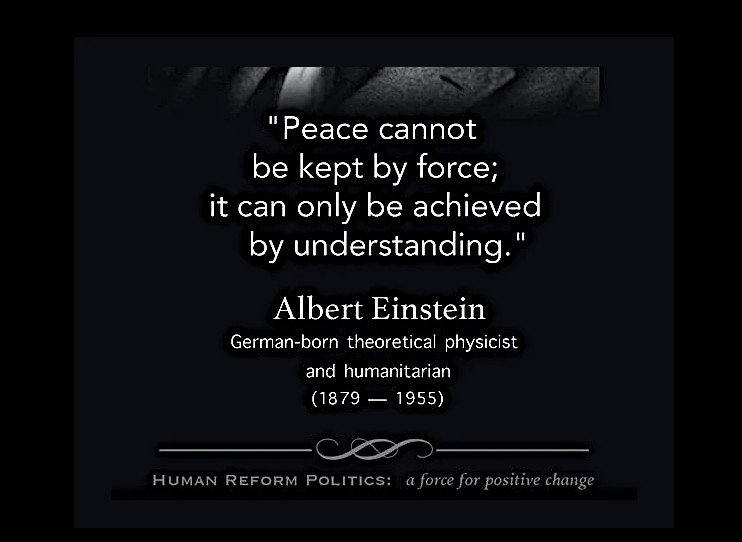

Imagine living on the only known planet in the infinite universe, where the mortified rich get richer by indoctrinating the people to follow an ancient dogma, repeating an ancient doctrine of sacrifice, projected onto innocent children, again and again, the rich get richer, and the children inherit a brutal indoctrination instead of Living Sacred Life. https://empathymatters.org/armageddon/
Secret History: How Evil Triumphs: