Do any kind of ethical instructions exist about applying NVC?
source :: https://nvcnextgen.org/2018/01/questions-and-answers-addressed-by-cnvc-certified-trainers/
Since “NVC” (AKA: Self-Empathy) is our natural human language, so I get curious about “natural ethics”
Five ethical principles emerge as I consider this question:
-
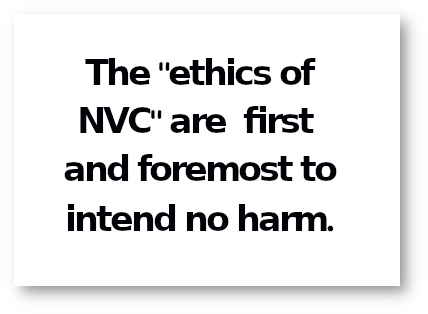
- Nonviolence: The “ethics of NVC” are first and foremost to intend no harm. When harm occurs accidentally, NVC can be used for repair work and healing.
-
- Self-responsibility and freedom: The “ethics of NVC” require self-responsibility. I feel ___________ because I need _____________. NVC, for me, is designed as a strategy to support me in connecting to my own feelings and needs and taking responsibility for them. NVC is NOT designed to tell other people what they should or should not do. NVC offers expanded choice, it does not limit choice.
-
- Interdependence: The “ethics of NVC” require me to remember that my needs do not exist in a vacuum; rather my needs are interdependent with yours. I do not want to get my needs met at your expense, nor do I want you to get your needs met at my expense.
-
- The Zero Step: The “ethics of NVC” require me to remember the intention of NVC (to support a quality of connection that inspires compassionate giving and receiving) and the attention of NVC, the present moment. My partner Jori and I use a nickname for this essential combination, the Zero Step.*** In other words, what comes before we “use” the model or the process? This, for me is the whole key to NVC. When I remember the Zero Step, all of the rest of NVC flows naturally.
- Safety and Protection: Although the intention of NVC is connection, that connection can occur only if there is safety. Thus, assessing safety and following up with protection, if needed, must come before connection.
(i.e. the protective use of force.****)
~Marshall Rosenberg
————————————
…::”The highest form of human intelligence… is to observe, without judgment. ~Jiddu Krishnamurti ♡
NVC :: OFNR :: OBSERVATION♡, Feelings, Needs and Requests ♡
OBSERVATION♡ without evaluation consists of noticing concrete (real) things and actions around us. We learn to distinguish between judgment and what we sense in the PRESENT moment, and to simply OBSERVE what is there (right now).
When you call yourself an Indian or a Muslim or a Christian or a European, or anything else, you are being violent. Do you see why it is violent? Because you are separating yourself from the rest of mankind. When you separate yourself by belief, by nationality, by tradition, it breeds violence. So a man who is seeking to understand violence does not belong to any country, to any religion, to any political party or partial system; he is concerned with the total understanding of mankind.”
~Krishnamurti
…::” Violence is not merely killing another… It is violence when we use a sharp WORD… when we make a gesture to brush away a person, when we obey because there is fear… So violence isn’t merely organized butchery in the name of God… in the name of society or country… Violence is much more subtle… much deeper… and we are inquiring into the very depths of violence.” ~Krishnamurti ♡
—
Marshall Rosenberg understood that INSTEAD OF “lashing out” or “withdrawing”, the willful use of our own internal empathic nature will give us a third option: Both an INTER and INTRA-personal connection of the kind most likely to lead to satisfying relationships and mutually agreeable strategies.
🌱 IFS & Peace 🌿 See Chat
See Chat
🌱 IFS & Projection 🌿 See Chat
Question: Why do we humans project our unconscious “parts” onto other human beings, while not even seemingly noticing that we are doing that?
Answer: This phenomenon touches right at the heart of human psychology and our relational patterns.
From an IFS perspective, we project our unconscious parts onto others because these parts carry burdens that feel too painful, threatening, or overwhelming to acknowledge directly.
Think of it like this: when we have an exile carrying deep hurt or shame, or a manager/firefighter working overtime to keep us safe, these parts operate beneath our conscious awareness.
They become like shadows that we don’t even realize are there.
Here’s the fascinating part – our psyche is actually trying to protect us!
When we can’t bear to hold certain feelings or beliefs about ourselves, our system “outsources” them onto others. It’s much easier to see these qualities in someone else than to face them in our own inner world.
This creates what we might call “psychological blind spots” – we genuinely aren’t aware we’re doing this because the parts doing the projecting are themselves unconscious.
The process is almost like our internal parts are constantly asking: *”How can I keep this person safe from pain?”* And sometimes their answer is: *”By making sure they see the problem as ‘out there’ rather than ‘in here.'”*
This is where the beautiful work of making unconscious beliefs more conscious comes in – as mentioned in approaches like Coherence Therapy. When we develop what we might call a “harmony mindset” rooted in empathy, we begin to question our automatic judgments.
We start asking ourselves: *”What am I protecting myself from seeing? What part of me is being triggered right now?”* Carl Rogers’ concept of active listening becomes crucial here – when we truly listen to others (and ourselves) with curiosity rather than judgment, we often catch glimpses of these projections.
The key is approaching both our inner experience and others’ with genuine compassion.
The good news?
Every time we recognize this pattern, we’re reclaiming our projection and bringing it back into our own system where it can be witnessed, understood, and eventually unburdened.
It’s like taking back borrowed energy that was never ours to carry in the first place.
🌱 IFS & The 8 C’s 🌿 See Chat
The 8 C’s in IFS represent qualities of the Self – your core, wise essence that naturally emerges when you’re in Self-leadership:
1. **Curiosity** – Genuine interest in understanding your parts without judgment
2. **Compassion** – Deep caring and kindness toward all your parts
3. **Calm** – Peaceful, centered presence even amid inner turmoil
4. **Clarity** – Clear seeing of what’s happening inside
5. **Confidence** – Trust in your ability to navigate internal experiences
6. **Courage** – Willingness to face difficult feelings and memories
7. **Connectedness** – Feeling linked to others and something greater
8. **Creativity** – Access to new solutions and possibilities When you lead from Self rather than from your parts, these qualities naturally arise.
For example, instead of being overwhelmed by an anxious part (which might make you act from fear),
Self-leadership allows you to approach that part with curiosity and compassion.
These Self qualities are essential for healing – they create the safe, trusting environment parts need to share their burdens and eventually let them go.
They also model how we might approach global conflicts: with curiosity about different perspectives, compassion for all involved, and the courage to find creative solutions together.
“The finest emotion of which we are capable is the mystic emotion. Herein lies the seed of all art and all true science. Anyone to whom this feeling is alien, who is no longer capable of wonderment and lives in a state of fear is already dead.
~Albert Einstein
🌺🌺🌺
..::”For me, the Jewish religion, like all others, is an incarnation of the most childish superstitions… And the Jewish people have no different quality for me than all other people”.
🌺🌺🌺
Einstein viewed the “cult of individuals” as unjustified and often in bad taste, noting that it was unfair to select a few for “boundless admiration” while ignoring everyone else.
(He explicitly stated he could not see anything “chosen”
about Jewish people)
”Refusing humility traps you in delusion.
One and the same.
~Marshall Rosenberg
🌺🌺🌺
“Nothing is more despicable than respect based on fear.”
🌺🌺🌺
Imagine living on the only known planet in the infinite universe, where the mortified rich get richer by colonizing the people to follow debunked dogma, repeating an ancient doctrine of war, projected onto innocent children, again and again, the rich get richer, and the children inherit a brutal indoctrination instead of Living Sacred Life. https://empathymatters.org/armageddon/
The phrase “Domination leads to Ritual Sacrifice” bridges the gap between historical sociology and ancient anthropology.
Throughout history, domination—the exertion of control, barbaric power, or authority over others—has frequently been inextricably linked to ritual human sacrifice.
This connection manifests in both structural power dynamics and ancient religious practices.
The transition from domination to human sacrifice is essentially the barbaric projection of unhealed guilt onto other human beings, often innocent children.
What’s #memoricide ?
It’s time to save our stories, our history, our truth.
#emmaswords #wordsmatter
"The myth [has been shattered] that the state of Israel has any interest in Jewish safety."
— Zeteo (@zeteo_news) May 27, 2026
Hannah Einbinder, @mahmoudkhalel, Isabella Hammad, and @simonerzim unpack the "shattering" myths of Zionism. pic.twitter.com/atJTF7xCzd
Amos Goldberg, Professor of Genocide Studies at The Hebrew University in Jerusalem "Yes, it is genocide. It's so difficult and painful to admit it, but we can no longer avoid this conclusion. Jewish history will henceforth be stained"
— BladeoftheSun (@BladeoftheS) May 27, 2026
Is there anyone more qualified and unbiased? pic.twitter.com/gAx1J2o1QN
via Brad Blinstrub ” Amen. What we are seeing is the march of the Khazars. A disaster renamed Israel.
via EnterTheUnseen ” If you truly understand the bridge between Spirit & psyche, you’d NEVER condone forcing religious beliefs on others &/or disempowering people’s spiritual decision making. It’s abusive behavior that breeds religious trauma, which creates fear-based neural associations to divinity.
1 of 3