‘ Richard Schwartz, PhD ’ ❤️🙏🌍 Self :: compassion, curiosity, clarity, creativity, calm, confidence, courage, and connectedness.
IFS Meditation
..::“It’s not psychological safety if people can only voice what you want to hear. The goal is not to be comfortable. It’s to create a climate where people can speak up without fear. Psychological safety begins with admitting our own mistakes and welcoming criticism from others.”
~Adam Grant
psychologist, #1 NYT bestselling author
_____________________________
related: https://hbr.org/2023/02/what-is-psychological-safety


Transformation
When ‘The Self’ becomes the leading intelligence in our lives, we create more harmony—both within ourselves and in our external lives.
This statement reflects the core idea of the Internal Family Systems (IFS) model, which suggests that inner harmony is achieved when the “Self” (a core essence of wisdom and compassion) becomes the leading intelligence, guiding the other “parts” of the mind. By shifting from a single, dominant identity (“mono-mind”) to an integrated “internal family” led by the Self, individuals can heal wounded parts, build self-trust, and experience more balance in both their internal and external lives.
How the Self leads to greater harmony Internal harmony:
By accessing the “Self,” which is described as calm, compassionate, and wise, you can begin to understand and heal the different “parts” of your psyche, such as the “Exiles” (wounded parts) and “Managers” and “Firefighters” (protector parts). When these parts are unburdened from their extreme roles, they can return to their natural, positive qualities, leading to less internal conflict.
External harmony: As you become more aligned with your true Self, your external actions are more likely to match your internal feelings and beliefs, a state known as congruence. This authenticity leads to greater self-trust and helps you build more genuine and trustworthy relationships with others. Key concepts from the Internal Family Systems (IFS) model.
The Self: A calm, compassionate, and confident core essence of every individual that is the source of healing and harmony.
Parts: Different aspects or sub-personalities that make up the psyche, such as “Managers” (who try to keep things in check) and “Firefighters” (who react impulsively).
“Mono-mind”: The belief in a single, unified self, which is seen in the IFS model as an outdated and limiting way of viewing the mind.
Burdens: Extreme beliefs and emotions that have been “unburdened” from wounded parts, often due to past trauma.
Integration: The process of bringing the different parts of the psyche into a harmonious relationship, led by the Self, to promote emotional healing and well-being.
Understanding the neuroscience of transformational change, as outlined by Bruce Ecker's "coherence" approach, can help us to make our unconscious beliefs into conscious awareness, and then to pair these beliefs with fresh new experiences that disconfirm or challenge (and hopefully update!) our view of reality.
There are two types of change: incremental change, which is often slow and takes more effort to maintain, and transformational change, which can happen in a moment and is effortless to maintain. Given the benefits of the latter, this video outlines how to facilitate transformational change in our own personal growth work. While transformational change happens in a single moment, that isn't to say it is always easy. We have to be a bit strategic. Why? Because for transformational change to occur, the brain must be gently presented with two very specific sources of information simultaneously. First, what did we learn about reality in the past. (This is called reactivation.) In order to reactivate the schema stored in implicit memory we need to emotionally experience the memories from the past. This emotion is required to become aware of our brain's deepest beliefs about how the world works (our schemas) and to open these neural nets up for rewiring. This is not an easy task since what our brain most fervently believes is often completely unconscious to us. That's why it can be helpful to have an experienced and trusted partner to help facilitate this reactivation process. The second step is to notice examples from our current experience that don't align with the old map of reality that we developed in childhood. This process is called disconfirmation. When a deeply felt schema from our past is juxtaposed along side an updated and disconfirming experience from our present then the brain chooses to rewrite the schema in order to resolve any contradictions. Through updating our outdated beliefs about reality we can alter the behaviors that derive from an old belief system and achieve deep and lasting shift in perception.Internal Family Systems Therapy, Explained. In this video Dr. Tori Olds will share how IFS Therapy understands trauma through the frame of parts work and uses the techniques of unblending from parts to help heal trauma and gain freedom from "emotional flashbacks."
Dr. Tori Olds will also discuss the IFS concept of exile parts and describe the relationship between protectors and exiles.
Dr. Tori Olds will also provide a brief description of the neuroscience of trauma, trauma flashbacks and why traumatic experiences can still feel so present in our bodies, years after the traumatic event. And finally, explain how once we have been able to connect with our "big S self," our "true self" is able to go beyond managing our emotional reactions to actually healing our trauma by caring for our traumatized exile parts.
#toriolds #partswork #ifs #trauma
Part 5:  • Internal Family Systems: Explained
How IFS therapy helps us to reconnect and care for our wounded inner child. Dr Tori Olds describes how “parts” work helps us to bring about a long-awaited reunion between this inner child and a wiser, more compassionate adult self or “true Self.”
Through gently asking our defenses (protector parts) to step aside, we are able to provide true guidance and care to the young parts of our self that are scared, angry or ashamed but have been exiled from our conscious awareness. When this hurt inner child that we had previously hidden away, senses the presence of our caring adult self, they are finally able to feel safe enough to be seen.
The protector “parts”, also developed in childhood, sensing a wiser, stronger, more capable presence, are able to let go of their defensive strategies for protecting the wounded inner child.
IFS: Internal Family Systems:
The Self is characterized by qualities like the 8 C’s in IFS: compassion, curiosity, clarity, creativity, calm, confidence, courage, and connectedness.
Then, from that state, we can explore and transform our relationships with the parts that were blocking our goals and life vision.
Finally, we are more able to lead personal and work lives from the state of Self-leadership which creates harmony and authenticity in all relationships.
Founder of Internal Family Systems, Richard Schwartz provides a demonstration.
The Four Basic Goals of IFS
1. Liberate parts from the roles they’ve been forced into, so they can be who they’re designed to be.
2. Restore trust in the Self and Self-leadership.
3. Reharmonize the inner system.
4. Become more Self-led in your interactions with the world.
~Schwartz, Richard, Ph.D.. No Bad Parts (p. 33).
IFS :: Basic Terms
Self: In IFS, the Self is the core or spiritual center of a person, characterized by qualities like compassion, calmness, curiosity, and clarity. “Self” is the essence of who we are beyond our parts.
Parts: Everyone has different ‘parts’ or sub-personalities, which encompass a range of emotions, thoughts, and behaviors. These parts are often developed to protect and manage psychological pain.
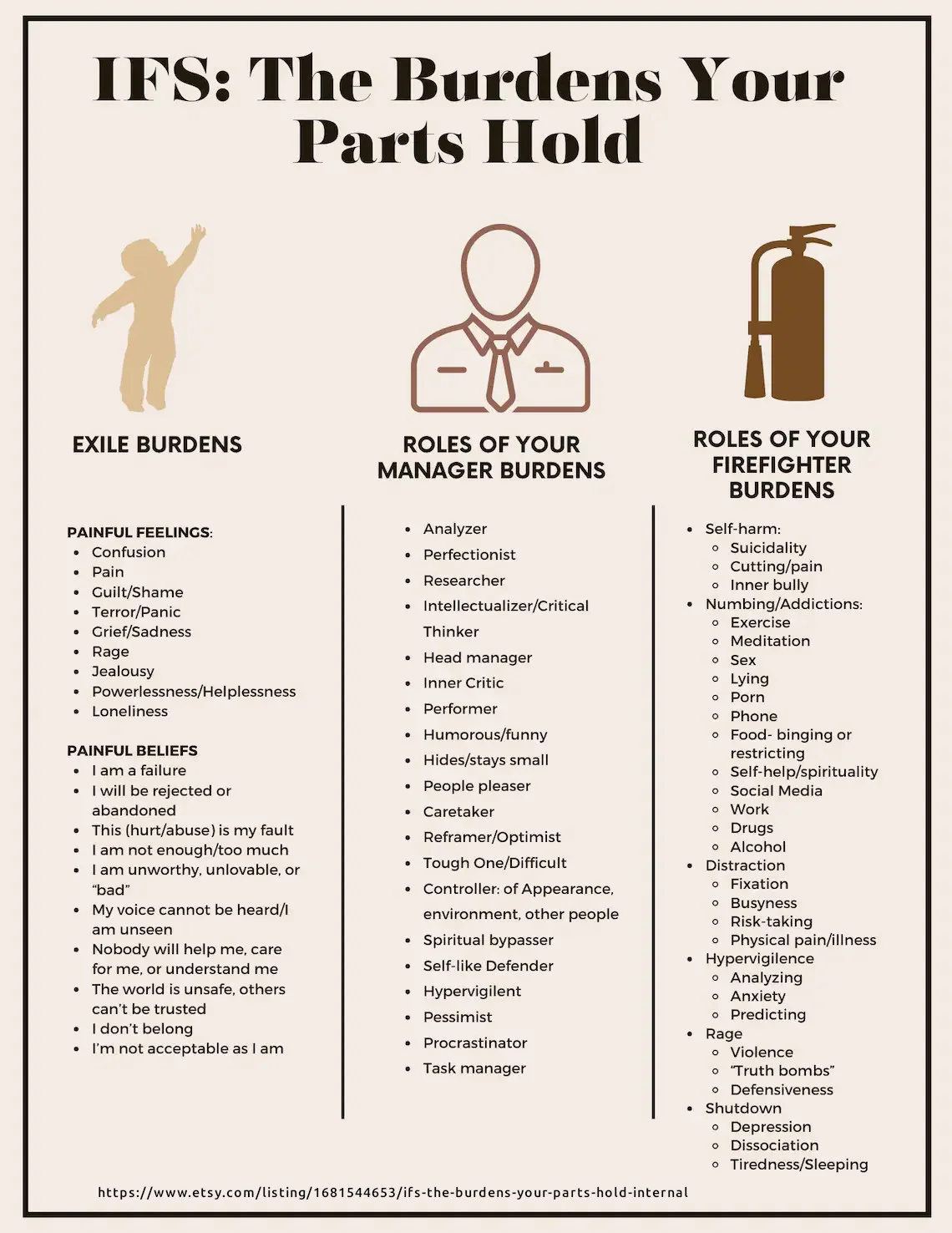
Exiles: Are vulnerable, wounded parts, often carrying burdens from traumatic experiences or pain. They are usually hidden away or repressed by other “parts” that are attempting to protect us from experiencing suppressed emotions.
Managers: These parts work to keep the exiles suppressed and maintain a functional level of consciousness and behavior. They are responsible for managing daily life and protecting us from harm.
Firefighters: When an exile’s pain becomes overwhelming, firefighters emerge to distract or soothe us, often through impulsive behaviors like addiction or aggression which can have destructive consequences.
Burden: A burden is a mistaken belief, emotion, body sensation or role that a part carries, which usually originates from past traumatic experience. It can influence how parts operate within the system.
Unblending: This involves supporting parts to separate gently from the Self. It helps us experience that we are not only our parts, but rather have parts, and this allows us to make decisions with more perspective and from a place of greater calm.
Integration: The hope in time is for the greater integration of all parts into the Self, so they can relate harmoniously. This Involves acknowledging, understanding, and healing our exiled parts and their protectors.
The IFS model emphasizes that all parts have positive intentions and that healing comes from understanding and harmonizing these internal families or systems.
8 C’s in IFS: compassion, curiosity, clarity, creativity, calmness, confidence, courage, and connectedness.
The “5 Ps” of IFS (Internal Family Systems) are Presence, Perspective, Patience, Persistence, and Playfulness.
These are qualities of the Self that help in approaching inner work with a lighter, steadier attitude, fostering emotional growth and transformation. They represent the traits that help individuals approach their inner system in a way that builds trust and allows for healing.
Presence: Being with what is, and accepting the present moment without an urgent need to fix things.
Perspective: The ability to see the bigger picture of a situation or internal conflict.
Patience: Understanding that progress takes time and approaching the process without adding pressure or expectations.
Persistence: The ability to keep going even when it is challenging.
Playfulness: Introducing lightness, humor, and spontaneity to make the therapeutic space feel safer for parts to be spontaneous.
IFS Outline:
https://ifs-institute.com/resources/articles/internal-family-systems-model-outline
How does IFS address conflicts between parts?
In Internal Family Systems (IFS), conflicts between parts, also known as polarizations, are addressed by fostering internal dialogue led by the core Self.
The process involves unblending from the conflicting parts, approaching each with curiosity and compassion, understanding their positive intentions, and ultimately healing the underlying wounds held by exiled parts.
The five-step process
Identify the polarized parts: The first step is to recognize the inner conflict and notice the specific parts involved in the opposition.
A person might feel torn between a “perfectionist” part that fears failure and a “rebel” part that avoids pressure by procrastinating.
Instead of trying to “pick a side,” the goal is to see both sides of the conflict.
Unblend from the parts: When parts are in conflict, they are often “blended” with the person’s consciousness, causing them to feel completely taken over by one of the parts.
For example, a person may say, “I am a procrastinator,” instead of, “A part of me wants to procrastinate.”
Gently unblend from these parts, allowing them to observe the inner conflict from the calm and grounded perspective of the Self.
Listen to each part with curiosity: Once the Self is leading, the individual can approach each polarized part with empathy and curiosity to understand its true intentions.
For instance, a person might ask the perfectionist part, “What are you afraid will happen if we don’t push hard?” and ask the rebel part, “What do you fear if we don’t push back?” Both parts can reveal a shared, deeper goal, such as preventing feelings of shame or inadequacy.
Find common ground and negotiate: With the Self mediating the internal dialogue, the parts can begin to see that they are both working toward the same shared goal of well-being, even with their different methods.
The Self can help them negotiate and collaborate on a resolution that honors both of their needs.
For instance, they might find a compromise by setting achievable goals while also scheduling regular breaks.
Heal the exiled parts: The polarization between protective manager and firefighter parts often exists to protect a vulnerable, exiled part that holds a past trauma.
For example, the perfectionist and procrastinator may both be protecting a young exiled part that felt humiliated after making a mistake. By creating a safe internal environment, the Self can tend to this exile and help it release its emotional burden.
Once the underlying wound is healed, the polarized protective parts can relax and take on healthier, non-extreme roles in the system.
What are some exercises to help polarized parts find common ground?
Here are several exercises from Internal Family Systems (IFS) to help polarized parts find common ground, ranging from simple visualization to more involved journaling techniques. The key is for your core Self to act as a compassionate mediator, not a judge.
1. Two-handed polarization exercise
This is a straightforward, sensory-based exercise for a conflict between two parts.
Setup:
Sit in a quiet space and place your hands, palms up, on your lap.
Invite one conflicting part to bring its energy into one hand and the other into the opposite hand. You may feel a difference in weight, temperature, or a slight vibration.
Steps:
Acknowledge and unblend: Notice how you feel toward the part in each hand. If you feel anything other than curiosity and compassion, another protective part may be blended with you. Ask any judging parts to relax back so your Self can be present.
Facilitate dialogue: Hold each part in your awareness and address them both. Tell them, “I hear you are in a conflict, and I am here to listen to both of you.”
Explore fears: Ask the part in your dominant hand, “What are you afraid will happen if you don’t do your job?” or “What do you fear if the other part has its way?” Listen for its response.
Repeat for the other part: Repeat the same questions for the part in your other hand. Listen for its perspective and concerns.
Find common ground: Ask them both, “What are you ultimately trying to achieve for me?” This question often reveals a shared positive intent, such as avoiding harm or seeking peace.
Thank them: Close by thanking both parts for sharing their perspectives.
2. Dialogue journaling
This is a powerful technique for creating a structured conversation between two conflicting parts, mediated by your Self.
Setup:
Find a journal and writing utensil.
Dedicate different parts of the page to each voice. For example, write from the Left-side-part on the left, the Right-side-part on the right, and the Self in the middle.
Steps:
Write from the Self: Begin by writing a statement from your Self that invites the parts to speak without judgment. For example, “I, the Self, want to hear from both the part that wants to overwork and the part that wants to give up. I will listen without taking sides.”
Express each part’s view: Allow the “overwork” part to write its piece, expressing its anxieties about failure and its strategy to protect you.
Switch to the other part: Then, let the “give up” part write its piece, detailing its exhaustion, feelings of inadequacy, and its reasons for wanting to stop.
Explore fears and intent: As the mediator, ask questions of each part, and write out their answers. Probe for their deepest fears and what they are protecting.
Synthesize and negotiate: Write a summary from the Self, pointing out the common ground you discovered. Ask both parts to consider a new, collaborative approach.
Write out a possible compromise, like, “I will commit to working on this project in a focused way, but I will also schedule mandatory breaks and celebrate small milestones.”
3. The room technique
This is a visualization exercise for creating safe distance between your Self and the parts in conflict.
Setup:
Find a quiet, calm space.
Close your eyes and visualize a serene internal space, like a quiet room or a peaceful meadow.
Steps:
Invite the parts: Imagine the two parts that are in conflict entering the room and taking seats. They can be visualized in any form that feels right, as figures, colors, or images.
Separate and observe: As the core Self, notice your feelings toward each part. If you feel impatience or anger, ask that impatient or angry part to step back.
Facilitate conversation: With curiosity and compassion, address the two parts. Ask them to look at each other and speak their fears and motivations. You can ask one part to speak first while the other listens respectfully.
Move to common ground: Ask them what they think the other part is trying to do for you. Often, they can recognize the other’s good intention once they feel heard.
Negotiate a new role: Suggest a new, less extreme role for each part, based on their newfound mutual understanding. For example, the overly critical part might become a “helpful reviewer,” and the avoidant part might become a “self-care advocate.”
General tips for all exercises
Be patient: Depolarization takes time and trust. Don’t expect instant agreement.
Always lead with Self: If you find yourself judging or getting frustrated, that’s another part trying to take over. Gently ask that part to step back.
Connect to exiles: The conflict is likely rooted in the pain of a hidden exiled part. Once the protectors trust the Self, you can work to unburden the underlying exile.
Respect resistance: If a part is resistant, don’t force it. Thank it for what it has shared and let it know you are available to listen again another time.
What happens if a Self-like part interferes with Self’s mediation?
When a “Self-like part” interferes with mediation, it essentially hijacks the process, preventing true healing and connection from the core Self.
Unlike the genuine Self, which is present without an agenda, a Self-like part has a hidden motive, typically to manage a situation or control other parts for protection.
How a Self-like part interferes
The presence of a hidden agenda:
While a Self-like part may mimic the outward qualities of calmness and curiosity, its actions are driven by a specific goal. This agenda might be to “fix” the problem, soothe an exiled part too quickly, or avoid discomfort.
The genuine Self, in contrast, is open to wherever the process leads.
A “false” healing connection: A Self-like part might attempt to fast-track healing by skipping steps or rushing an interaction with a vulnerable exiled part.
However, the exile can often sense the inauthenticity and will not truly unburden itself, leading to stalled or superficial progress.
Resistance from other parts: Other parts in the system, especially those involved in the conflict, can sense the Self-like part is not the true leader. They may become more distrustful, uncooperative, or resistant to the mediation process, worsening the polarization.
Feeling drained or unfulfilled: After a session led by a Self-like part, a person may feel drained, frustrated, or like something is missing. There is often a subtle lack of fulfillment, even if the session seemed productive, because the true, healing connection from the Self was absent.
Effortful, rather than effortless, leadership: Being in genuine Self feels effortless and spacious. A Self-like part’s leadership, by contrast, feels like a performance—a tiring, active effort of “trying really hard” to be compassionate or wise.
How to handle a Self-like part
Spot the signs of interference: Pay close attention to your internal experience. Do you feel a subtle sense of “trying” or an underlying agenda?
Are other parts unusually resistant or skeptical? If the process feels forced or performed, a Self-like part may be in the lead.
Turn curiosity toward the Self-like part: Instead of getting frustrated, use your Self-energy to address the interfering part directly. Ask it questions like: “What is your positive intention for trying to lead this negotiation?” or “What are you afraid will happen if you step back and let the real Self lead?”.
Build trust with the Self-like part: Recognize and appreciate the Self-like part for its protective efforts.
Like all protectors, it believes its strategy is necessary to keep you safe. Thank it for its role and reassure it that the genuine Self is now present and can handle things.
Ask it to step back: Once the Self-like part feels understood and appreciated, ask for permission for it to step back. The goal isn’t to get rid of it, but to help it relax from its extreme role so the true Self can emerge and mediate the conflict.
Reconnect with genuine Self-energy: Once the Self-like part unblends, take a moment to re-center and reconnect with your core Self. Notice the shift in feeling—the effortless calm, clarity, and genuine curiosity that signify your Self is now in the lead.

IFS: A Step-by-Step Guide to Creating Wholeness
Using IFS, 3rd Edition
Understand your psyche in a clear and comprehensive way, and resolve deep-seated emotional issues. Self-Therapy makes the power of a cutting-edge psychotherapy approach accessible to everyone. It is incredibly effective on a wide variety of life issues, such as self-esteem, procrastination, depression, and relationship issues. IFS helps us all to comprehend the complexity of our psyche. Dr. Earley shows how IFS is a complete method for psychological healing that you can use on your own.
Self-Therapy is also helpful for therapists because it presents the IFS model in such detail that it is a manual for the method.
Internal Family Systems Therapy (IFS) has been spreading rapidly across the world.
No Bad Parts w/ Richard Schwartz
This guided meditation, taken from the “IFS and Trauma” video series (available at www.IFSCA.ca and led by Dick Schwartz invites you to calmly get to know the protective parts of your own system.
_______________
DEMYSTIFYING THE INTERNAL FAMILY SYSTEMS MODEL
Richard Schwartz, Ph.D., shares ways to use Internal Family Systems to better understand yourself, heal your emotional afflictions, and embody your core self. To read more about Dr. Schwartz and peruse the full show notes, go here 👉🏾https://www.richroll.com/podcast/richard-schwartz-761/ ✌🏼🌱 – Rich Roll
Dick Schwartz: IFS and Trauma
8 C’s in IFS:
compassion, curiosity, clarity, creativity, calm, confidence, courage, and connectedness
IFS 6 Fs:
Find, Focus, Flesh it out, Feel, beFriend and Fear
IFS 5 Ps:
Presence. Patience. Perspective. Persistence. Playfulness.
5 F’s of Trauma:
responses are fight, flight, freeze, fawn, fine, and faint.
Six principles of trauma-informed care: safety; trustworthiness and transparency; peer support; collaboration and mutuality; empowerment, voice and choice; and cultural issues.
https://justmind.org/internal-family-systems-model/
Internal Family Systems Model Outline
https://ifs-institute.com/resources/articles/internal-family-systems-model-outline
Exiles and Unburdening
The Art and Neuroscience of Transformational Change: Dr Tori Olds
Bruce Ecker’s mentor was Dr. Robert Shaw, MD, who was very influenced by Werner Erhard. 🙏
I consider this work ontological fundamentally. Blessings
Dr. David Kamnitzer, DC
In metaphysics, ontology is the philosophical study of being, as well as related concepts such as existence, becoming, and reality.
“Release the grip of self-doubt;
you are not the enemy you fear.
Embrace your complexities, your parts—they’re all pieces of the same inherently calm human.
Schema Therapy and Coherence Therapy:
interview with Pierre Cousineau
How Our Schools Thwart Passions
Peter Gray | TEDxAsburyPark