“We are like a torn tapestry and we all have to be responsible for making the threads that we weave golden.
It is the only honorable thing to do.
~Marianne Williamson
“Do not be daunted by the enormity of the worlds grief. Do justly now, Love mercy now, Walk humbly now. You are not obligated to complete the work, but neither are you free to abandon it.” ~The Talmud
Book Sharing — Event Signup Form:
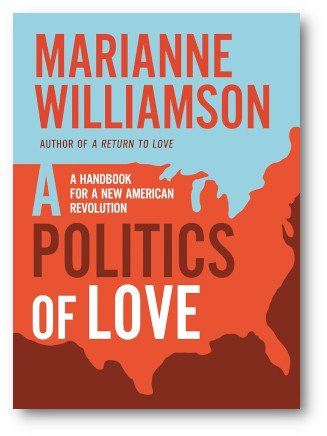
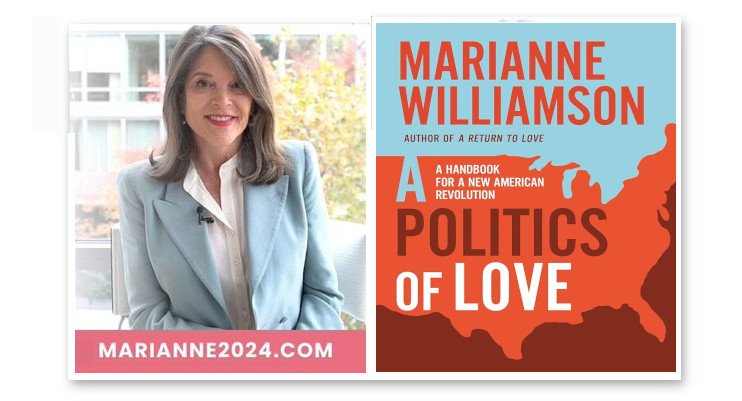
A Politics of Love: A Handbook for a New American Revolution by Marianne Williamson
https://marianne2024.com/donate
An Empathy Circle Discussion Group with Empathy Circle Facilitators DJ Chandler, Janna Weiss
“Humanity has come to a fork in the road. There is a way marked Love and there is a way marked Fear, each path leading to more of the same . . . In our finest hours, America has stood for what humanity at our best aspires to be. We have sometimes succeeded and sometimes failed, but today, in our time, it is ours to decide our path as we move forward. Lady Liberty’s torch is in our hands, but only we can determine whether it burns within our hearts.”
– A Politics of Love
In A Politics of Love, Democratic candidate for United States President Marianne Williamson confronts a politics of fear with a powerful new paradigm that turns love into a political force. Marianne urges all Americans to reach into our hearts to reclaim our love for democracy and our passion for the possible. Only that, she says, will heal our country and our world.
Marianne Williamson is an internationally acclaimed author, teacher, and activist. Six of her books have been New York Times bestsellers. Her books include Healing the Soul of America, Tears to Triumph, A Return to Love, A Year of Miracles, The Law of Divine Compensation, The Gift of Change, The Age of Miracles, Everyday Grace, A Woman’s Worth, and Illuminata.
A Politics of Love is available here:
https://www.harpercollins.com/products/a-politics-of-love-marianne-williamson
What is an Empathy Circle? An Empathy Circle is a structured dialogue process based on mutual active listening. The process increases constructive dialogue, mutual understanding, and connection by ensuring that each person feels fully heard to their satisfaction. The basic process can be fairly easily learned in about 15 minutes or less. It’s a lifelong practice to deepen. The Empathy Circle practice is the most effective gateway practice for learning, practicing and deepening listening and empathy skills, as well as nurturing an empathic way of being.
More info: https://www.theempathycenter.org/
How to Empathy Circle:
https://www.empathycircle.com/how-to-empathy-circle
How to Empathy Circle: ( multilingual ) https://empathymatters.org/now/how-to/
EmpthyCircle outline: ( multilingual ) https://empathymatters.org/now/cohort
Sundays: January 7 – March 3, 2024
| 4 -5:30 PM PT | 6 -7:30 PM CT | 7 -8:30 PM ET |
by Marianne Williamson
https://marianne2024.com/donate
An Empathy Circle Discussion Group
with Empathy Circle Facilitators
DJ Chandler, Janna Weiss
“Humanity has come to a fork in the road. There is a way marked Love and there is a way marked Fear, each path leading to more of the same . . . In our finest hours, America has stood for what humanity at our best aspires to be. We have sometimes succeeded and sometimes failed, but today, in our time, it is ours to decide our path as we move forward. Lady Liberty’s torch is in our hands, but only we can determine whether it burns within our hearts.”
– A Politics of Love
In A Politics of Love, Democratic candidate for United States President Marianne Williamson confronts a politics of fear with a powerful new paradigm that turns love into a political force. Marianne urges all Americans to reach into our hearts to reclaim our love for democracy and our passion for the possible. Only that, she says, will heal our country and our world.
Marianne Williamson is an internationally acclaimed author, teacher, and activist. Six of her books have been New York Times bestsellers. Her books include Healing the Soul of America, Tears to Triumph, A Return to Love, A Year of Miracles, The Law of Divine Compensation, The Gift of Change, The Age of Miracles, Everyday Grace, A Woman’s Worth, and Illuminata.
A Politics of Love
is available here:
https://www.harpercollins.com/products/a-politics-of-love-marianne-williamson
What is an Empathy Circle?
An Empathy Circle is a structured dialogue process based on mutual active listening. The process increases constructive dialogue, mutual understanding, and connection by ensuring that each person feels fully heard to their satisfaction. The basic process can be fairly easily learned in about 15 minutes or less. It’s a lifelong practice to deepen. The Empathy Circle practice is the most effective gateway practice for learning, practicing and deepening listening and empathy skills, as well as nurturing an empathic way of being.
More info: https://www.theempathycenter.org/
How to Empathy Circle:
https://www.empathycircle.com/how-to-empathy-circle
How to Empathy Circle: ( multilingual )
https://empathymatters.org/now/how-to/
EmpthyCircle outline: ( multilingual )
https://empathymatters.org/now/cohort
Sundays: January 7 – March 3, 2024
| 4 -5:30 PM PT | 6 -7:30 PM CT | 7 -8:30 PM ET |
Love in a Time of Crisis: Lessons in Fear and Love … Pages 1-34
Suggested topic: What does “a politics of love” mean to you?
or: Whatever is alive in you.
Marianne Williamson Quotes:
“To the analytical mind, the journey of the soul seems irrelevant.
And that is the beast. From there, we are lost.”
see also: “Fundamental A.E.”
“The ego mind is very sly and it’s not a big leap from ignoring the pain of others to ignoring the fact that you yourself are inflicting pain on others.
Once we give ourselves social permission to think that money, not love, is the organizing principle of a well-adjusted society, chaos is inevitable.
Yet American politics has developed for decades in a direction that has had increasing disregard for such tender mercies. Hard data, hard facts, and quantifiable factors are what’s deemed to be real — serious, sophisticated, and relevant — making the separation of head from heart more justifiable and tenable.
Williamson, Marianne. A Politics of Love (p. 8).
see also: “cognitive dissonance”
We are living, breathing, divinely created beings on this earth for a high and mighty purpose. No politics, and no political establishment, that fails to see us that way or treat us that way is worthy.
~Williamson, Marianne. A Politics of Love (pp. 9-10)
We don’t just need a progressive politics or a conservative politics; we need a more deeply human politics. We need a politics of love. p. 10
America has been driven into a corporate straitjacket… Our government has become a system of legalized bribery… money and power.
A fear-based, undemocratic influence has infected some of our most important institutions, and ancient thought forms of oppression and domination have reappeared among us. And we, like generations before us, are called upon to respond.
Williamson, Marianne. A Politics of Love (p. 11).
A politics of love is a holistic perspective on human change, addressing the internal as well as external aspects of societal dysfunction. p. 14
The love that will save the world is not only a love for our own children, but a love for everyone’s children. And it isn’t just a desire to save our own homes; it’s a realization that this planet is everyone’s home.
We need a revolution of the heart. p. 18
A democratic revolution can’t be fought once, as in 1776, and then simply considered handled. p. 22
A politics of love sees the world through reverent eyes, viewing love, not economics, as the most enlightened organizing principle for human civilization.
This view represents a fundamental change in our human, political, and economic priorities—not merely an incremental approach to bettering society.
Williamson, Marianne. A Politics of Love (p. 27).
In the words of the French philosopher Pierre Teilhard de Chardin, “Someday, after mastering the winds, the waves, the tides, and gravity, we shall harness for God the energies of love, and then, for a second time in the history of the world, man will have discovered fire. Williamson, Marianne. A Politics of Love (pp. 27-28).
It is not naive to suggest that we reorient our politics around love’s purposes. What’s naive is to think that we can afford not to, and retain either our freedom or our survival as a species. Williamson, Marianne. A Politics of Love (p. 28).
When I was growing up, the one thing that was never allowed in our house was whining. We were told that if we had a challenge, we had to rise to it. And where the world was broken, it was our job to repair it. My father grew up in deep poverty and was very sensitive to issues of social justice. He knew what it meant to be poor, he knew what it meant to be hungry, and he knew how large and powerful systems can keep such misery in place. Throughout my childhood, a constant refrain was “Fight the system, kids! Fight the system!
Williamson, Marianne. A Politics of Love (p. 30).
Too often, when it comes to the suffering of others, we look but we do not see. When I became an adult and began to write and speak about spirituality, my father at first seemed to think I’d betrayed his values. He had taught me about society at large, and he could not understand my focus on personal transformation.
“I raised you to fight the system, to wage the revolution!” he exclaimed to me one day. I replied, “But, Daddy, I am! Love is the revolution! It’s the only way that things will fundamentally change.” I saw a twinkle in my father’s eye when I said that. He did understand.
One of my most precious memories is walking into my parents’ bathroom one day when my father was shaving. He was listening to one of the early cassette tapes of my lectures, and as I entered the room he turned to me, put down his razor for a moment, and said, “Very good, Little Sister. I’m proud of you.” Today, twenty years after my father’s death, I feel at times like I’m still trying to get his approval.❤️
Williamson, Marianne. A Politics of Love (p. 31).
Those who love peace must learn to organize as effectively as those who love war.” Martin Luther King Jr.
A Revolution of Love: Reviewing the Plot … Pages 35-68 (34 pages)
Suggested topic:
How might imagination and/or knowledge contribute to a revolution of love?”
or: Whatever is alive in you.
Marianne Williamson A Politics of Love Quotes:
“You can’t pick up a novel in the middle of the book and have any idea what’s going on… the same is true with story of a nation. (p. 35)
Knowledge is power, and withholding knowledge is a tool of all oppressive systems. Under resourcing education, particularly among children, and corporate consolidation of the news media have been powerful tools in the dumbing down of the American mind. Without an informed and passionate citizenry, democracy is not a problem for its enemies at all. (p. 38)
With our imagination, we give birth to new realities. We can envision the world we want and then work back from there. We can imagine a world at peace, a planet healed, and all sentient beings happy. We can visualize those things and commit ourselves to their manifestation. (pp. 64-65)
We need to recognize that the endless application of brute force will not bring peace to the world, and that only the soul force of justice, meaningful human relationships, forgiveness, and compassion can end the scourge of violence on our streets and throughout the world. p. 63
With our imagination, we give birth to new realities. We can envision the world we want and then work back from there. We can imagine a world at peace, a planet healed, and all sentient beings happy. We can visualize those things and commit ourselves to their manifestation. (pp. 64-65)
“Marianne surprised me in these pages. She revealed her sense of history and made it clear that historical knowledge, memory, and consciousness matter. In fact, it was the best presidential campaign book I had ever read. And I have read most of them”
~ Harvey J. Kaye https://twitter.com/marwilliamson/status/1744103724383932652
Video of pages 59-60
https://twitter.com/summerbrighton/status/1661467277261438976
Love and Conflict: Disagreeing With Love
Pages 69-96 (28 pages)
Suggested topic:
How might listening open a safe space for sharing?
or… whatever is alive in you.
A Politics of Love Quotes:
A politics of love has as much to do with how we listen as with the things we say. Partly because I had shared with them an Easter service filled with prayer and meditation that morning, and partly because my friends are lovely people whom I genuinely like, I could hear them at lunch that day without reactivity. I felt no constriction in my heart, no negativity, no judgment. We were meeting in Rumi’s field “beyond good and bad, right and wrong,” which is the only place where souls can meet. I heard a thing or two that deepened my understanding of where they were coming from, and I like to think that maybe I said a thing or two that had an impact on them as well. I mentioned at the table that it should be part of our spiritual practice to remember that no one has a monopoly on truth. Our capacity to listen to each other is more urgently needed now . . . (pp. 70-71)
“While the ego always monitors other people’s thoughts and behavior, the spirit would have us monitor only our own…
…it is only in purifying our own hearts that we have any chance of touching someone else’s…
That has to be our goal now: not mere defeat of political opponents, but also engagement in the art of moral persuasion — the ability to so commune with the heart of another that real communication can occur.
Williamson, Marianne. A Politics of Love (p. 76).
This is not a time for personal weakness, but for strength. The only real strength is love; love makes us vulnerable, but in a way that makes us strong. It doesn’t turn us into wounded birds. It makes us powerful and strong and courageous, intellectually and emotionally. We must not indulge our hopelessness now, resigning ourselves to the idea that the concentrated assaults on everything from the planet to our democracy have succeeded to such a degree that it’s no longer possible to stop them.
~Williamson, Marianne. A Politics of Love (pp. 90-91)
Economics of Love: A New Bottom Line
Pages 97-132 (36 pages)
Suggested topic:
What do you think about honesty and kindness related to economics?
A Politics of Love Quotes:
~Williamson, Marianne. A Politics of Love (pp. 117-118)
The narrative of our past is not one in which Americans consistently folded in the face of economic injustice; it is one in which, more typically, the American people railed against such injustice and ultimately prevailed. The question of whether capitalism has a moral responsibility to people and the planet is not new. American brilliance applied to business has always been one of our greatest strengths, but we are also a people for whom ethics matters. Our history has been marked by an ongoing struggle between the engines of economic prosperity, on the one hand, and the ethical considerations that make life meaningful and righteous, on the other. The sacrifice of our moral core to the false god of short-term economic gain is as morally dangerous for our society as it is for an individual. A morality that applies to everything except the things that affect real people’s daily lives is not morality at all. It is our moral responsibility to insist on just enough regulation of American business and to give enough pushback to an otherwise unfettered, amoral capitalism.
~Williamson, Marianne. A Politics of Love (pp. 120-121)
An unfettered global capitalism, untethered to any ethical considerations beyond its fiduciary responsibility to stockholders, is both a political and spiritual abomination. Any system that lacks compassion, love, and conscience is out of alignment with the moral laws of the universe and in time will produce chaos. It is spiritual voices that should decry such injustice—and often do. In his 2013 exhortation on global capitalism, Pope Francis said: While the earnings of the minority are growing exponentially, so, too, is the gap separating the majority from the prosperity enjoyed by those happy few. The imbalance is the result of ideologies which defend the absolute autonomy of the marketplace and financial speculation. . . . A new tyranny is thus born, invisible and often virtual, which relentlessly imposes its own laws and rules. . . . The thirst for power and possessions knows no limits. In this system, which tends to devour everything that stands in the way of increased profits, whatever is fragile, like the environment, is defenseless before the interests of a deified market, which become the only rule. (pp. 124-125)
Eileen Fisher said that she believed stock sharing with employees should be mandatory. “I think corporations should have to share a minimum 10 percent of their profits with the people working. It’s not socialism; it’s good for business.”
“Whole Foods CEO John Mackey has founded a movement called “conscious capitalism,” calling upon corporate leaders to reintroduce ethics and values into corporate governance.
“Danone Corporation, converted its entire corporate structure to a B-Corporation (or B-Corp.). A B-Corp. bases its success on social and environmental performance, going beyond profit maximization.
~Williamson, Marianne. A Politics of Love (p. 126).
There are good politicians who see what has happened and are trying to change it. There are good corporate leaders who see what has happened and are trying to change it. There are good social and political activists who see what has happened and are trying to change it. It’s time for the rest of us to weigh in.
~Williamson, Marianne. A Politics of Love (p. 132)
“A Journey to Conscious Capitalism”
https://www.youtube.com/watch?v=72HFGoY0Rrc
American Youth: Equal Rights for Angels
Pages 133-154 (22 pages)
Suggested topic: How might a politics of love help all children?
… or… whatever is alive in you?
A Politics of Love Quotes:
So many of America’s children are endangered either physically or emotionally, it should be seen as a humanitarian emergency. Obviously, the problem isn’t that we don’t love our children. But the love that will save the world is not just love for our own children. It is also love for children on the other side of town and the other side of the world. For every problem, whether personal or societal, the solution lies in the realization of our oneness and the expansion of our love.
~A Politics of Love, Marianne Williamson (pp. 133-134)
Who is to speak for them, if not us? And that is why politics matters. It’s not something “over there” to people whose lives must bear the impact of policies that work against their interests every day. An issue shouldn’t spark us only if it happens to impact us personally. Politics shouldn’t be just about you and yours, or me and mine. It’s about we and ours. Politics is the purview of our collective sensibilities and our collective decision-making. It should be a place where we address more than just what we want for ourselves; it should be a place where we come together to consider what is right for America. There’s a bigger question in life than “How am I doing?” And that’s “How are we doing?” Millions of children living in chronic distress in the richest country in the world is a form of collective child neglect. And that should matter to all of us.
~A Politics of Love, #Marianne_Williamson (p. 136)
Seventy-eight percent of incarcerated inmates in America came out of the child welfare system. ~A Politics of Love, #Marianne_Williamson (p. 137)
An increase in the number of children sent to foster care is a problem. The fact that the sex-trafficking industry has infiltrated the network of foster-care parents and even hovers over schools is a problem. But perhaps the worst problem of all is how desensitized we are to the urgency of the problem.
~A Politics of Love, #Marianne_Williamson (p. 137)
In the words of Nelson Mandela, “There can be no keener revelation of a society’s soul than the way in which it treats its children.”
~A Politics of Love, #Marianne_Williamson (p. 142)
Of course, we should teach our children reading, writing, and arithmetic. But our educational system should expand to include a more whole-person vision of what it takes to prepare a child for self-actualized life in the twenty-first century. We should help our children develop the emotional and psychological skills to navigate life in what has become an extremely complex world. Until we do that, our educational system will remain inadequate despite whatever funding we put into it.
~A Politics of Love, #Marianne_Williamson (p. 147)
–
Children should be taught not only what to think—as in science and math—but also how to think, as in honing their critical thought processes so they know how to think for themselves. America’s educational system should be the crown jewel of America’s investment portfolio, our greatest asset in producing creativity and progress. In the words of the poet William Butler Yeats, “Education is not the filling of a pail, but the lighting of a fire.” (p. 148)
Marion Wright Edelman, founder of the Children’s Defense Fund,
has termed the “cradle to prison” pipeline is
a moral scourge upon our country. 🇺🇸
~A Politics of Love, #Marianne_Williamson (p. 150)

Children’s Defense Fund :: architect Maya Ying Lin
Nothing holds more promise for the twenty-first century than a radical rethinking of our responsibility to children and young adults. This country should undertake a massive realignment of our resources in the direction of the young. We should make college or technical school available to everyone. We should cancel most college debts. And why should we do all these things?
To unshackle the American spirit, to release the chains that bind our circumstances, to liberate the potential in every citizen . . . and then to watch this country soar! America’s problem is the problem of a constricted heart. As individuals we are a good and decent people, but as a society we have become rather mean. It is time to reconsider. It is time to self-correct.
~A Politics of Love, #Marianne_Williamson (pp. 152-153)
——————————
via Janna: Twitter thread on children’s rights https://twitter.com/RealJannaWeiss/status/1724544365496848824
Child Welfare Abolition
Human Rights Watch | If I wasn’t poor, I wouldn’t be unfit https://www.hrw.org/report/2022/11/17/if-i-wasnt-poor-i-wouldnt-be-unfit/family-separation-crisis-us-child-welfare
NPR: ‘Deluged’ child welfare systems struggle to protect kids amid calls for reform
Repeal CAPTA https://www.repealcapta.org
TAKE ACTION Scroll down for individual sign-on https://www.repealcapta.org/take-action
1966: Children Imagine life in the year 2000
https://www.youtube.com/watch?v=xS8xX3usi4c&list=TLPQMDMwMjIwMjSKw9NDq0Kdyw&index=3
Race and Repentance: Out of Many, One
Pages 155-174 (20 pages)
Suggested topic: How can we abolish racism and how can we build beloved community?
… or… whatever is alive in you…
A Politics of Love Quotes:
No one always gets everything right, and neither does any country. Sometimes people and countries can do bad things. But the atonement principle, universal to all serious spiritual systems, posits the power of repentance. We can atone for our mistakes, make meaningful amends, and behave differently going forward. No life, and no country, can redeem itself otherwise.
The law of cause and effect, or what in the East is called karma, is the spiritual principle that organizes the universe. It is an unalterable law that every cause will create an effect; love calls forth love, and lovelessness calls forth lovelessness. Only through atonement and amends can this law be overridden. We can change things at the level of effect over and over, but only when we change things at the level of cause are they fundamentally altered. We must change our thinking as well as our behavior in order to change our lives.
A politics of love recognizes that the same spiritual, emotional, and psychological principles that prevail in an individual’s life also prevail in a nation’s. (pp. 155-156)
—
While most people realize the evils of slavery, many may not realize the extent to which social, economic, and political barriers prevented the integration into free society of the formerly enslaved population after the Civil War.
If you’ve kicked someone to the ground, you need to do more than just stop kicking; you have a moral responsibility to help them get back up. You can’t just say to four million people who have had no experience other than that of forced labor, “Glad you’re free! Now good luck to ya! Hope you find a good job!” What they were freed to was a violent prejudice, white supremacy, and segregation that would go unchallenged in any fundamental way for another hundred years. Thousands of black Americans fled to Northern cities in search of jobs and freedom denied them where they came from, yet racial prejudice routinely met them even there.
It was not until the mid-1950s and the 1960s that the horrors of segregation were met, challenged, and resisted by the Reverend Dr. Martin Luther King Jr. and the civil rights movement. The struggle of the civil rights movement was a heroic repudiation of racist oppression, and Dr. King became the target, both professionally and personally, of the full force of supremacist rage. From the lynching of integration rights workers to police brutality to church bombings and ultimately the murder of Dr. King, the white supremacist movement did not go down quietly.
Yet the movement prevailed. Dr. King was a Baptist preacher whose moral authority matched his towering intellect and political acumen. He realized that the movement’s political strategy had to be matched by its spiritual authority in order to awaken the conscience of a nation. Having gone to India and studied the nonviolent philosophy of Mahatma Gandhi, King applied the principles of nonviolence to the struggle for civil rights back in the United States. As a minister and then as a movement leader, King had the Gandhian “soul force” necessary to lead his people to the promised land of racial justice. It was not only the things he said but the things he did that parted the waters of racial hatred. Not only did he believe that love is the only force powerful enough to overcome hate; Dr. King displayed that love with the full force of his being. His combination of nonviolence and political courage stirred a nation that had long acquiesced to the ugliness of white supremacy, and under his leadership the civil rights movement created the political will to pass federal civil rights legislation.
After so much horror and bloodshed, Dr. King and others who struggled so valiantly beside him achieved a historic political victory. The Civil Rights Act of 1964 ended segregation in public places and banned employment discrimination on the basis of race, color, religion, sex, or national origin; the Voting Rights Act of 1965 prohibited racial discrimination in voting. (pp. 160-162)
~Williamson, Marianne. A Politics of Love (pp. 167-168)
Just as an individual needs to identify and admit his or her character defects, so America has to identify our character defects as a nation. There is a strain of racist thought and feeling that has been with us from the beginning and is with us still. It is time for us to face it, atone for it, make amends for it, and end it. People can transform, and so can countries. (p. 168)
It was the task of a previous generation to abolish slavery, and it is the task of our generation to abolish racism. As a whole-person response to the problems of our time, a politics of love recognizes that both internal and external healing is necessary if we’re to transform our country. Our sense of citizenship must include the purification of our hearts if we are to solve the problems of the world. In the words of Martin Luther King Jr., “The desegregation of the American South is the externalization of the goal of the civil rights movement, but its ultimate goal is the establishment of the beloved community.” (pp. 169-170)
A politics of love stands for more than incremental changes. It is a fundamental disruption, a revolutionary stance, and a proactive movement in the direction of a greater good. Whites can listen more to black Americans, and we should. Whites can do more to recognize the depths of white privilege, and we should. We can oppose voter suppression and disparities in our criminal justice system, and we should. We must do all those things. But we should also pay up. (p. 170)
Germany has paid $89 billion in war reparations to Jewish organizations since World War II, and the United States should pay reparations for slavery.
~Williamson, Marianne. A Politics of Love (p. 172).
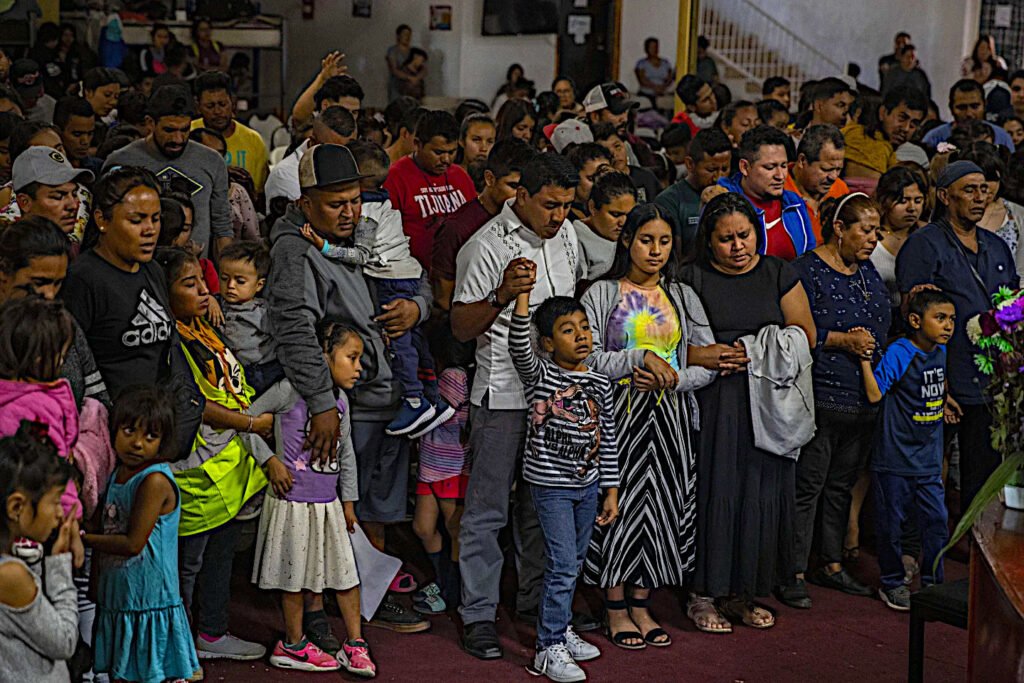
The Sojourner Among Us: The Hope of Immigrants
Pages 175-190 (16 pages)
Suggested topic: If you had someone else’s history, would you also have their point of view?
… or… whatever is alive in you…
A Politics of Love Quotes:
In, 2017 traveling with friends to the Za’tari camp, a Syrian refugee camp in Jordan, I met three adorable little sisters, so precious that I cried at having to leave them . . . Leaving the camp, I was silent in the car on the way back to our hotel. I wished everyone I knew in America could have spent the day as I had. (pp. 175-176)
Dehumanizing others has always been the required first step in the commitment of history’s collective atrocities. Demonizing others brings out the demons in those who demonize. (p. 178)
Poetry read quickly doesn’t penetrate the soul.
But poems such as this one, read slowly, savored and embraced, can change your entire view of being an American.
Not like the brazen giant of Greek fame,
With conquering limbs astride from land to land;
Here at our sea-washed, sunset gates shall stand
A mighty woman with a torch, whose flame
Is the imprisoned lightning, and her name
Mother of Exiles. From her beacon-hand
Glows world-wide welcome; her mild eyes command
The air-bridged harbor that twin cities frame.
“Keep, ancient lands, your storied pomp!” cries she
With silent lips. “Give me your tired, your poor,
Your huddled masses yearning to breathe free,
The wretched refuse of your teeming shore.
Send these, the homeless, tempest-tost to me,
I lift my lamp beside the golden door!” (pp. 183-184).
The humanity of all people should have everything to do with politics. (p. 186)
If our spiritual values matter at all, they must matter everywhere. And that includes in the arena of politics.
~Williamson, Marianne. A Politics of Love(p. 187)
Yusuf Islam the Artist also known as Cat Stevens
(via Janna: In Ethics for the New Millennium, the Dalai Lama defines
‘spiritual revolution’ as an ethical revolution.)
War and Peace: Fighting the Profits of War
Pages 191-214 (24 pages)
Suggested topic: A trigger-happy propensity for conflict can give way to the true love and wisdom of transformation.
… or… whatever is alive in you…
Quotes:
191
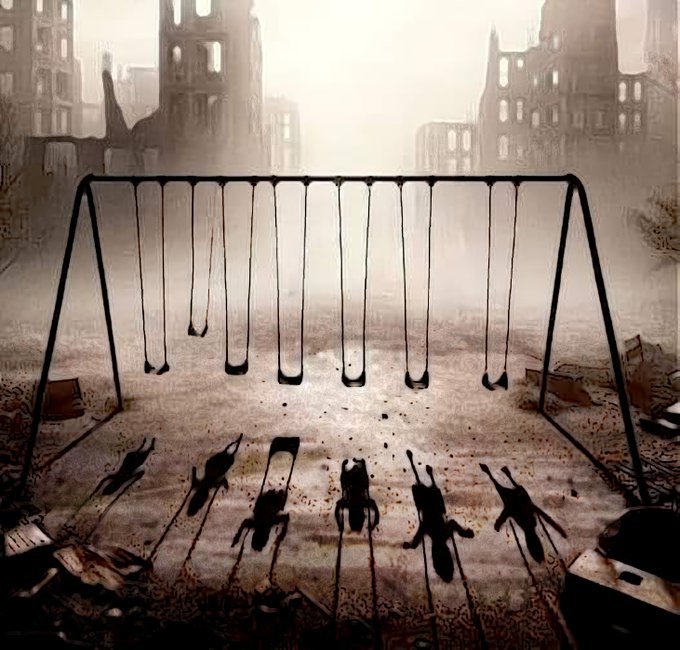
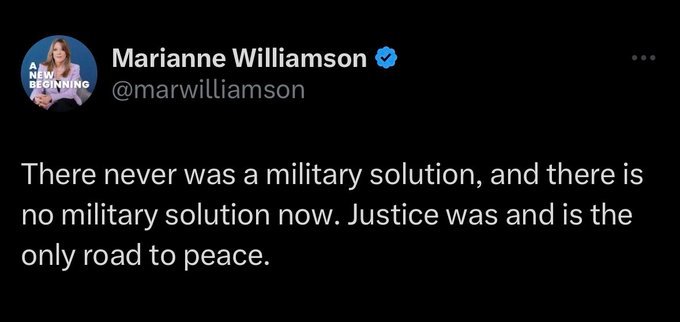
A politics of love is neither unsophisticated nor naive about the dangers of the world; it acknowledges the need for military preparedness. But in the world as it is today, we need to know as much about how to wage peace as how to wage war.
193-194
Traditional warfare addresses external realities, seeking to suppress or eradicate malignant symptoms. But with society as well as with the body, we ultimately cannot just treat symptoms; we need to treat their cause.
We can’t just fight the symptoms of hate; we must cultivate the love in the presence of which hate does not grow. Most of our problems are opportunistic infections, none of which would have gained such power had our societal immune cells been healthier. That is why cultivating justice and brotherhood is more than just a “nice” thing to do; by cutting off its oxygen, the politics of love is the most sophisticated response to evil. This century demands a different mental framework through which to view the entire notion of security. In today’s world, no amount or means of brute force can provide an absolute guarantee of our safety.
Williamson, Marianne. A Politics of Love (pp. 193-194).
198-199
It’s said that war is too important to be left to the generals, but it’s also too important to be left to the politicians. Our political establishment is enamored of the power of brute force, and undervalues the power of soul force. We need to adopt a new political mind-set if we are to deliver to our children and our children’s children any semblance of a peaceful world. Only those who are either ignorant of history or willfully blind to it can deny the role of widespread human despair, economic hardship, and lack of education in fostering eruptions of violence around the world. Only when we consciously and willingly address those issues in a meaningful way will we be paving the way to a sustainable peace on earth.
We can’t just go around fighting violence all the time; we must learn how to cultivate peace. At present, the resources we spend on building true foundations of peace—diplomacy, support for democratic institutions, expansion of economic opportunities for women, providing educational opportunities for children, and ameliorating human suffering—are minuscule compared to what we spend on defense.
Williamson, Marianne. A Politics of Love (pp. 198-199).
202
We realize that we must cultivate our health if we want to be healthy, not simply fight sickness when it appears. We should apply that same logic to issues of war and peace. We should know better than to think that we can avoid taking responsibility for peace and not expect war.
Active peace-building measures reinforce the social health of our planet the way good nutrition and exercise reinforce the physical health of our bodies.
Williamson, Marianne. A Politics of Love (p. 202).
203-204
We should establish a US Department of Peace to identify and foster domestic peace-creating projects in the United States; outbreaks of violence here are as horrifying as those anywhere else in the world. We could make peace-creation central to all domestic and international policy, not just in word but in deed. While some say it’s naive to believe that massively realigning resources toward helping people thrive — by leading efforts to eradicate global poverty, support democratic institutions, and expand economic and educational opportunities—is central to creating peace in the twenty-first century, we need to unabashedly insist that it’s naive to assume humanity will even survive the twenty-first century if we do not.
Williamson, Marianne. A Politics of Love (pp. 203-204).
205
The best way to create a more peaceful world is to treat people with greater compassion. Our task is to replace a politics of fear with a politics of love. Love is a wiser, more evolved, and more powerful modus operandi than fear, if our goal is to bequeath a habitable world to our children and our children’s children.
Williamson, Marianne. A Politics of Love (p. 205).
206-207
The women of America are key to challenging the insanity of America’s war habit. If nothing else, we should be awakened by the fact that more women and children die in wars than do male combatants. We should unabashedly stand up to militarism, viewing this stance as simply one more way of dismantling the patriarchy. Feminine values like nurturing children and caring for the home are not just peripheral issues; they are the keys to peace on earth. If Americans are to adequately deal with terrorism, we need to look deep into our own hearts and minds.
A trigger-happy propensity for war should give way to a taste for wisdom, maturity, and reflection. The false power of the tough cowboy should dissolve now, giving way to the genuine power of wisdom. We should reach not only for a rich society but for a good society, both in how we behave at home and in how we express ourselves abroad.
Williamson, Marianne. A Politics of Love (pp. 206-207).
212-213
Our vital national interests lie in protecting the 3.1 million children who die from hunger-related preventable causes each year, the 71 percent of the world’s population who live on less than $10 a day, and the nearly one billion people who live on less than $1.90 a day. It is the humanitarian aid workers, diplomats, and peace-builders who most serve our vital national interests.
The amelioration of unnecessary human suffering, both here and around the world, should be the bottom line of all US policy. It is not the radicalism of hate that is our biggest danger today; our biggest danger is that we lack the radicalism of love. That is the revolution now to be waged: a change in our thoughts, along with a change in our behavior, along with change in our institutions, along with a change in our votes, that will lead in time to a change in our world. Any conversation less radical than that simply plays into the hands of those who despise us.
We have the power to override the heinous efforts of those who terrorize, to overrule them and nullify their malevolence. But it cannot be done with mere military might. What we need now is our spiritual might. The real war is not without, but within: between ego-based fear and spirit-based love. That is the contest that matters the most, and it rages constantly inside our heads. Will we choose brute force or soul force to provide for our security? As long as we the people are not answering that for ourselves, there will always be others seeking to provide the answers for us. Whether we let them do so will determine the fate of our precious world.
Williamson, Marianne. A Politics of Love (pp. 212-213).
To Begin Again: The Choice Before Us
Pages 215-228 (14 pages)
Suggested topic: Mahatma Gandhi said that the real leader of the Indian independence movement was “the small still voice within.”
Have you ever heard it?
… or… whatever is alive in you…
Quotes:
216
Americans are a good and decent people, no different from people anywhere else. Although fear and bigotry have been harnessed for political purposes, we have love and decency we can harness too. But first we must find and harness them within ourselves. We all have to look at ourselves and check our judgments at the door. A nonviolent revolution begins with facing, and surrendering, the violence within ourselves.
Williamson, Marianne. A Politics of Love (p. 216).
219
Love is not passive; it is active in the world. And there is much to be done. In the words of Dr. King, “Those who love peace must learn to organize as effectively as those who love war. . . . When evil men plot, good men must plan. When evil men burn and bomb, good men must build and bind. When evil men shout ugly words of hatred, good men must commit themselves to the glories of love.”
Williamson, Marianne. A Politics of Love (p. 217).
220
We need reverence toward each other, toward the children of the world, and toward the planet itself. We need reconciliation with the God of our understanding, and radical forgiveness toward each other. We need to look at ourselves and ask how we can do better, devote ourselves to our country and to our children’s children, to rise up from the ashes of our self-preoccupation. We need desperately to evolve from “me” to “we.” Only then will our country rise—when we rise first.
Williamson, Marianne. A Politics of Love (p. 217).
223
Mahatma Gandhi said that the real leader of the Indian independence movement was “the small still voice within.” The small still voice within will lead our generation too, for it hasn’t gone away. It is an aspect of human consciousness. It is an eternal internal guidance system. Each of us has a job to do, a unique part to play in the repairing of our world, and we can be internally guided as to what part is ours to play.
Williamson, Marianne. A Politics of Love (p. 223).
224
Consider spending five minutes every day sitting with your eyes closed, sending love from your heart to everyone in your country, and then extending that love to every sentient being in the world.
Williamson, Marianne. A Politics of Love (p. 224).
226
If we truly want a different world, we must be willing to think in a different way and live in a different way than we do now.
226-227
Human beings can descend, but we can rise back up. We can choose wrongly, but we can choose again. Humanity has come to a fork in the road, and each of us is responsible for choosing which way we go now. There is a way marked Love and there is a way marked Fear, each path leading to more of the same. . . . We are not powerless at all. We are simply in the habit of disengaging from the things that matters most. We can change that.
~Williamson, Marianne. A Politics of Love
~Marianne Williamson 🌿
Invite your friends on Facebook:
https://www.facebook.com/events/1079560699883740/1079560706550406/?active_tab=about
and Linked-In
https://www.linkedin.com/events/7144444915807125504/comments/
Security Note:
Cornell University recommends only enabling file transfers during Zoom meetings when absolutely necessary.
This is because of potential security risks, such as sharing files that contain malware.
By default, Zoom allows meeting hosts and participants to transfer files to each other using the chat feature.
However, this feature can create a security concern if someone unexpected is able to join the meeting.
Here’s how to restrict file transfers in Zoom Team Chat:
In the navigation menu, click Account Management then Account Settings, Click the Team Chat tab,
Under Sharing, click the Users can share files in chats and channels, toggle to disable it.